Aquilino Corvo
La piel del tamborAquilino Corvo, Archbishop of Seville, is a practiced ecclesiastical operator whose campaign to clear Nuestra Señora de las Lágrimas for redevelopment exposes the bargains and rivalries beneath pastoral authority. He invokes discipline, procedure, and the diocese’s needs, but the threatened church becomes a test of what those terms conceal: institutional self-preservation, financial advantage, and his unresolved hostility toward Lorenzo Quart.
Identity and Position
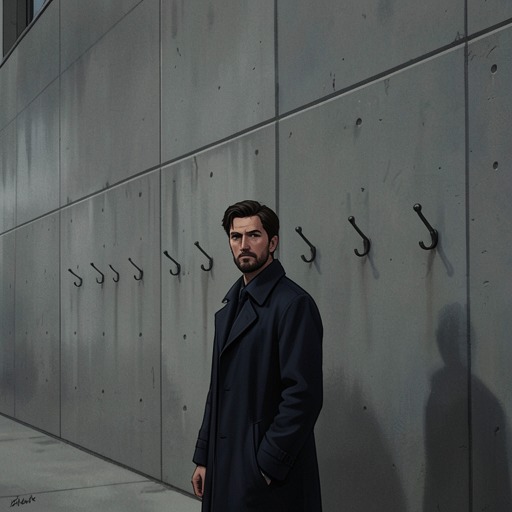
Corvo is a carefully selected churchman, skilled at maneuvering through political and ecclesiastical turbulence. His appearance is arranged to project authority: a long, angular face, sparse hair at the temples, a gold cross, and a large yellow stone in his episcopal ring. He cultivates the resemblance to the Prado’s The Nobleman with His Hand on His Chest, turning an art-historical pose into a private emblem of office. His influence rests on a broad network: support at the Nunciature in Madrid, backing from Opus Dei, and good relations with both the Government and the opposition in the Junta of Andalusia.
His balancing instinct extends beyond politics. Corvo follows bullfighting and holds a box at La Maestranza when Curro Romero or Espartaco perform. He is also a member of both local football clubs, Betis and Sevilla, a gesture presented as pastoral neutrality and political prudence. The joke in this even-handedness is also a governing principle: he avoids placing all his interests in one camp. Yet his public flexibility has a private limit. He hates Quart, whose earlier intervention in the security arrangements for the Pope’s Seville visit humiliated him and left a lasting grievance.
The Church and the Development Deal
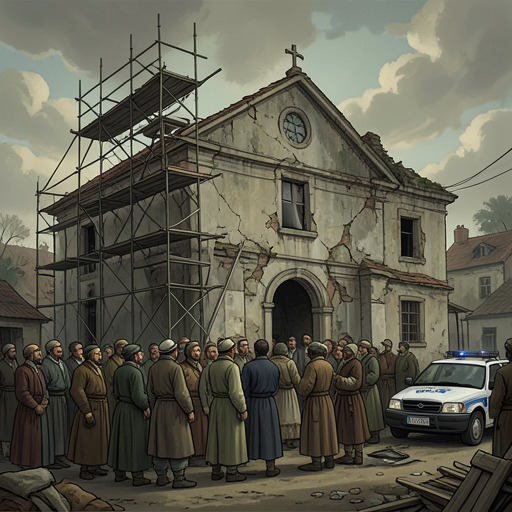
Corvo describes Nuestra Señora de las Lágrimas as condemned, insisting that its ruin makes demolition only a matter of time. The regional cultural authorities have abandoned preservation on budgetary grounds, and Seville’s municipal government is close to endorsing that position. The death of the municipal architect has delayed the administrative file, which Corvo dismisses as bad luck. In his account, the case is an obstacle-ridden matter of procedure; in practice, its resolution would serve a powerful redevelopment proposal.
A 1687 privilege is the immediate obstacle. It stipulates that the church retains its privileges as long as Mass is celebrated there each Thursday for the soul of its benefactor, Gaspar Bruner de Lebrija. Corvo explains that Gaspar apparently died on a Thursday, and the Bruner family had enough power to secure the condition. The arrangement is not merely antiquarian: it gives the parish a continuing claim that frustrates secularization, the prerequisite for demolition. Corvo recognizes that the local archbishop cannot simply forbid a parish priest from saying Mass, so the contest shifts from authority to discipline.
The proposed Banco Cartujano operation would use the church site and compensate the diocese generously, although the diocese has no clear title to the land beyond what Corvo calls its moral claim, founded on three centuries of worship. The bank also promises to fund a church in one of Seville’s poorest neighborhoods and establish a foundation supporting social work among the Roma community. Corvo presents this package as compelling in a period when parish collections barely sustain ordinary expenses. Its charitable provisions make the transaction easier to defend, but they do not erase the conflict of interest: the church’s demolition would bring material benefit to the institution charged with its pastoral care.
Ferro, Quart, and the Politics of Discipline
Corvo’s difficulty is that Príamo Ferro continues to celebrate the Thursday Mass and resists the archbishop’s pastorals and calls to order. Corvo has asked Rome to suspend Ferro from office, but says the process is slow. The Vatican computer intrusion has further delayed action, as officials wait for Quart to return with his report. Corvo depicts the matter as a disciplinary problem involving an elderly, stubborn priest, while using Roman procedure to avoid taking direct responsibility for the outcome.
Quart’s mission is formally to identify the author of a letter, maintain prudent contact with local church authorities, and handle the affair discreetly. Corvo offers him unconditional cooperation and asks to be kept informed, although both men understand the ceremony of the exchange: Corvo expects Quart to withhold information, while Quart expects the archbishop to obstruct his investigation. Their polished professional manners do not soften the underlying hostility. Corvo would relish seeing Quart make a mistake, and Quart reads the referral to Rome as an effort to pass the dangerous decision to someone else while keeping Corvo’s hands clean.
That antagonism has a history. When leaks from the Archdiocese exposed the hours and routes of the Pope’s visit to the Mediterranean, the Institute for External Works, with Quart acting urgently, overturned Corvo’s original security plan. The Nuncio’s report to the Pope nearly cost Corvo his newly acquired Seville see. Though Corvo later established himself as an excellent prelate, the humiliation and Quart’s part in it continued to trouble him. His opposition to the investigator is therefore not simply a dispute about jurisdiction or Ferro; it is also the return of an old debt dressed in the formal language of church affairs.
Compromised Neutrality
Corvo’s conduct around the proposed operation shows how easily institutional caution can become an instrument of pressure. Pencho Gavira, who is leading the development, has serious personal problems with Macarena Bruner, his wife or possibly estranged wife. Macarena openly supports Ferro, giving the dispute a personal counterweight to Gavira’s political and financial influence. Corvo warns that the bank’s plan could backfire because of her involvement, yet he also knows that public opinion may cast him as the prelate who coerced a poor parish priest to profit from selling the site. Scandal, he admits, frightens him.
Later, Corvo insists that Quart was not sent to Seville to act against Ferro but to supply Rome with specialized information, and that the Seville see cannot act directly as a matter of ecclesiastical form. He describes himself as watching from the sidelines, with his hands tied, while simultaneously emphasizing the priest’s age, disciplinary difficulties, and the overlap between local and Roman concerns. The account is technically careful but politically useful: it keeps the archbishop near the center of the process while allowing him to disclaim responsibility for its pace and direction.
The threatened demolition also attracts people who see the church as an interest to be managed rather than a place of worship to be protected. When Ferro names Corvo, Banco Cartujano, and Gavira as parties with reasons to want the church gone, Quart answers that Rome cares about every church and priest. The exchange marks the divide between the investigator’s stated institutional purpose and the parish priest’s suspicion that power is already arrayed against him. Corvo’s position is especially exposed because his religious authority and the proposed commercial benefit converge on the same contested site.
Exposure and Reversal
Ferro’s past gives Corvo another means of weakening the priest’s credibility. A decade earlier, while serving at Cillas de Ansó, Ferro faced an ecclesiastical inquiry after church property disappeared: a crucifix and a fifteenth-century panel attributed to the Master of Retascón. He received only a simple reprimand. Further investigation established that the missing panel had been acquired legally by the Madrid auction house Claymore and resold at a much higher price; Ferro had received a small payment from the dealer, Francisco Montegrifo. Quart suspects that Corvo is not displeased to see this history circulate, and even wonders whether Bonafé’s source may be connected to the archbishop. The novel does not establish that suspicion as fact, but it shows how a real blemish in Ferro’s record can be deployed within a present struggle over discipline and the church.
Corvo’s confidence appears most plainly in his pleasure when he believes Rome has conceded defeat. Smoke from his pipe accompanies his satisfaction as he tells Quart that Rome has surrendered and claims that Vísperas has made fools of both Rome and its investigator. Quart answers that Corvo himself should have acted earlier: Nuestra Señora de las Lágrimas and Ferro belong to his diocese, and the archbishop’s failure to intervene left room for the crisis to grow. The rebuke turns Corvo’s chosen posture of restraint against him. What he presents as prudence and procedural limitation can also be read as a failure of local responsibility.
Quart leaves the meeting beneath the painted ceiling of the Prelates’ Gallery and passes the Giralda, recalling that Seville’s bishops once imprisoned disobedient priests in the Parra jail. He imagines that Ferro—and perhaps Quart himself—might have exchanged views in a cell while Corvo sent his account to Rome through slow official channels. The thought makes the contrast between old coercion and modern procedure vivid without suggesting that power has vanished: it has acquired files, phones, and jurisdictional language. As Quart reaches the stairs, Corvo calls him back. The archbishop’s satisfied expression has disappeared; he says they need to talk. The reversal leaves their contest unresolved and reveals that Corvo’s apparent triumph has not secured the last word.